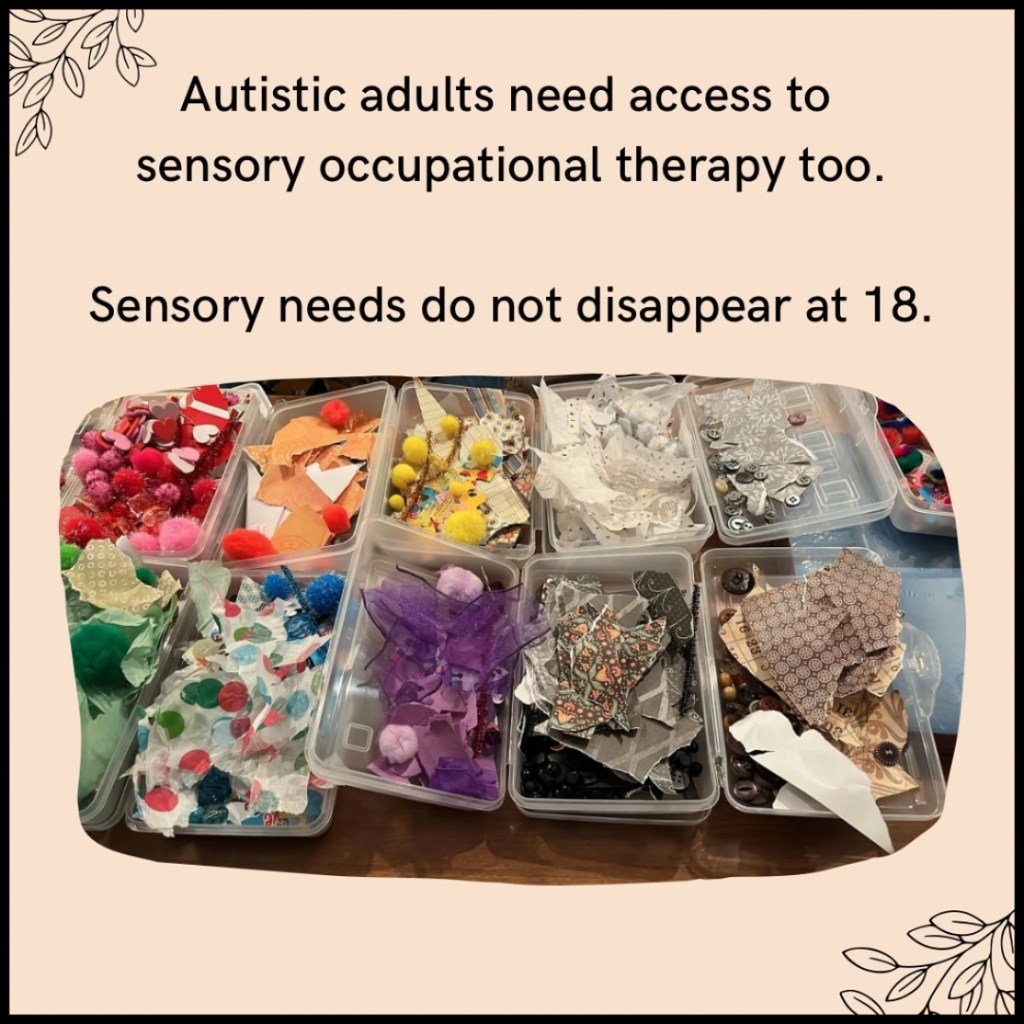
As an adult, it’s almost impossible to find a local occupational therapist that can address sensory needs and supports. I’m sure it exists in some areas, but not here.
Once you age out of the pediatric clinics, that’s usually it. You’re on your own. When we’ve tried to find local adult OT clinics that have interest in sensory supports, we have found nothing.
In the pediatric clinic, they accepted patients up to around 22; it was perfect for me. We worked on coming up with sensory strategies, learning how to navigate interoception, and joining the Transitioning to Adulthood group. I was very upset when I had to stop going, partially because I was close to the age limit – but also because we had to travel an hour to get to the clinic. I lost a lot of progress I’d gained from it.
In the adult clinic, I was told that they “don’t do sensory” and that they would focus on only “important” things like some of my cognitive skills. I went along until I was discharged soon after, because “autistic adults can’t really learn new skills after 18.”
We tried to get OT through home and community based services, hoping for in-home supports.
We were told it was impossible, but that they’d happily send out an ABA therapist each week for “behavioral support.” We refused, although they tried to convince me and my support staff that I needed it.
Eventually, I gave up – as do many other autistic adults and their families.
I’m grateful for friends, caregivers, and even physical therapists who try to come up with ways to improve my sensory regulation. They aren’t occupational therapists, and my caregivers have not had any formal training on sensory processing needs at all. My physical therapists are not ‘trained for sensory’ either, but they research and learn anyways.
- We create games for gross motor skills and vestibular movement, and also work on skills to improve my proprioception.
- We practice my fine motor skills with play dough, therapy putty, and embroidery.
- We work together on projects that require sorting and organizing, often for events or volunteer things.
- We work on interoception skills using worksheets online and from my regular therapy appointments.
My friends and loved ones shouldn’t have to be the ones to help me navigate my own sensory needs and systems. Unfortunately, this is true for so many other people – whether it’s due to a lack of resources, funds, or simply nonexistent. Not having access to occupational therapy is just one of the many supports that families go without, even regardless of age. Meanwhile as we get older, those services somehow become even harder to find, afford, or access.
Autism doesn’t disappear at 18, so why do our supports?
The “supports cliff” for autistic adults is real, and it is hard.
 Just Keep Stimming
I’m 58 and still have massive sensory issues. I actually think they get worse with age. Or maybe our tolerance just wears down.
LikeLike